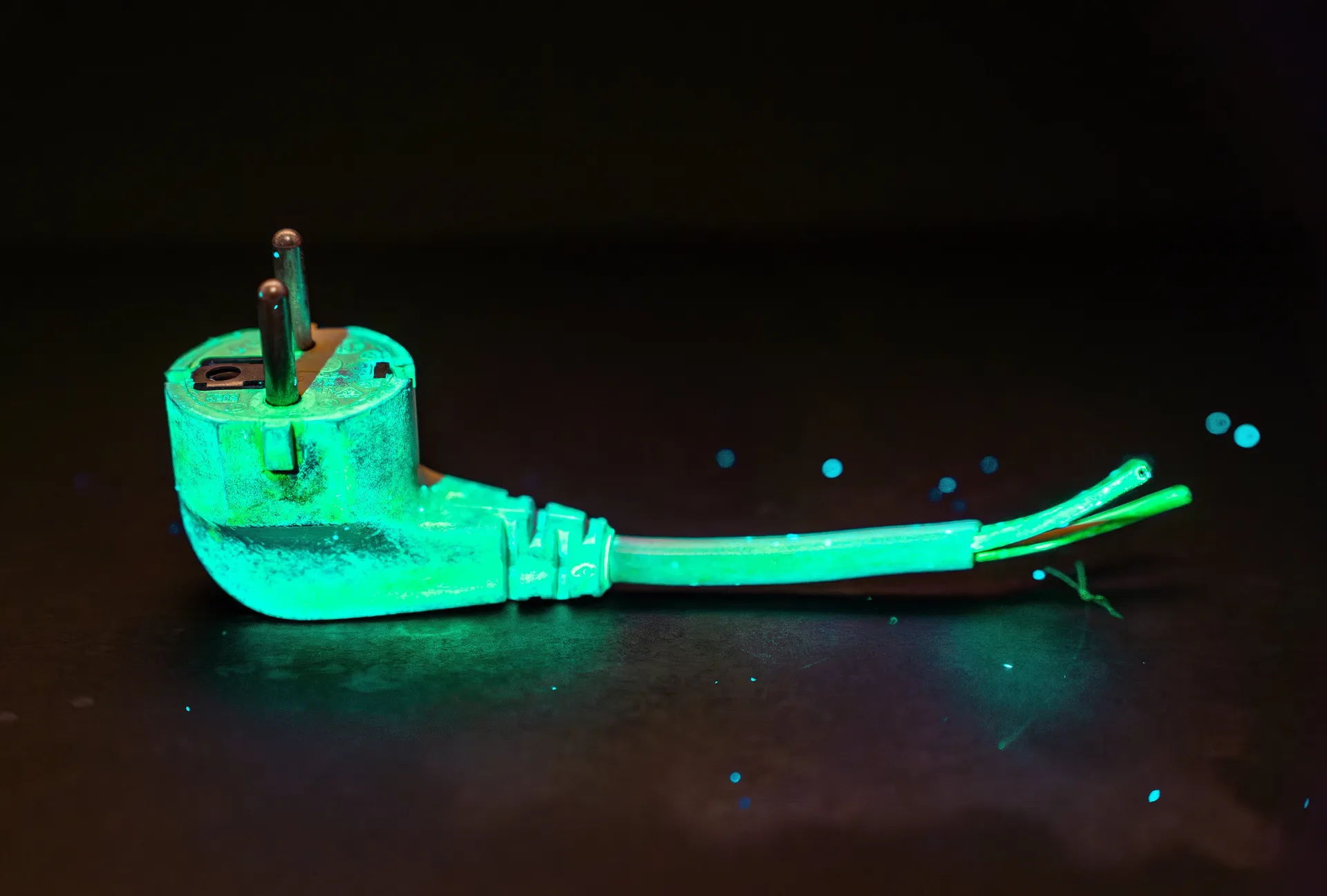
Researchers at AMOLF have utilized the unique properties of perovskite semiconductors to develop a simple spraying test for demonstrating the presence of Lead. Perovskite is a material suitable for use in LEDs and solar cells.
A surface containing Lead shines brightly green when sprayed with the test. This test is 1,000 times more sensitive than existing tests, and researchers have found no false positives or false negatives. The study was published on November 27 in the Journal of Environmental Science and Technology.
“We have redirected perovskite semiconductor technology and used it in a widely deployable Lead test. Nobody in this field had ever thought of it,” explains Lukas Helmbrecht, a researcher in the Self-Organizing Matter group led by Wim Noorduin at AMOLF. “We are very pleased with these results,” says Noorduin. “It’s a really cool project, and it’s quite rare for fundamental research to have a literal impact on the entire world with an application.”
Science at home
A few years ago, the group developed a two-step process to transform a calcite structure, such as the skeleton of a sea urchin, into a semiconductor. The calcium carbonate in the skeleton reacts and transforms into Lead perovskite, a semiconductor material that emits light under UV light.
While stuck at home during the COVID-19 pandemic, Noorduin pondered other possible applications of this material. At the same time, he learned about significant health risks associated with Lead exposure, especially for young children who can suffer brain damage. A simple test to demonstrate the presence of Lead could help reduce such exposure, and perhaps the electroluminescent properties of Lead perovskite could contribute to it.
Noorduin took home a solution that could form perovskite if it came into contact with Lead and sprayed it on a gutter. It immediately emitted a bright green color. To his surprise, the same thing happened with the paint on the adjacent window frame, which also lit up. Both surfaces contained a form of Lead. The green light is luminescent and reveals the formation of Lead perovskite semiconductor. “It worked so easily that we started thinking about developing a test to detect Lead on a wide range of surfaces.”
Only Lead lights up
Helmbrecht took up the challenge and found that a methylammonium bromide solution was the most effective. As soon as this solution comes into contact with a Lead compound, it immediately forms Lead perovskite, which lights up bright green under UV light. Helmbrecht tried a range of surfaces, from Lead pipes and paint to Lead salts, glass, and plastics such as PVC and electrical wires. They all lit up bright green, proof of the presence of Lead. If an iodide or chloride solution is used instead of bromide, the emitted light is respectively red or blue.
Furthermore, Helmbrecht tested over fifty materials that did not contain Lead but contained similar elements, such as tin, aluminum, and copper. None of them lit up. This indicates that the test is highly chemoselective. The test reveals Lead concentrations of one nanogram per mm2, while most current tests have an accuracy not exceeding a few micrograms per mm2. The new test is, therefore, 1,000 times more sensitive.
Discoveries in Lead Detection Chemistry
It is interesting to note that the Lead compound in which the material contains metallic Lead or one of the Lead salts does not matter. Noorduin explains: “It seems that all compounds are converted into what is called Lead 2+ valence. We are not surprised that the chemical reaction only works with Lead. We know this from research on perovskite solar cells and LEDs. The limited reaction is a disadvantage for solar cells, but for our test, it is an advantage because it makes the test very selective. However, we were surprised that the test works for so many different Lead-containing materials.
The exact course of the chemical reaction is still under study, Noorduin explains. “We think it is a multi-step process in which Lead first dissolves a bit, undergoes possibly a redox reaction, and then forms a Lead salt, which is then transformed into perovskite. However, the reaction is so fast that we are not sure about it but able to detect the steps.
The knowledge gained from this study, which after all started with research on perovskite semiconductors, could in turn stimulate the same type of research in the development of better solar cells or LEDs from perovskite, for example.
Health benefits worldwide
A spin-off from this research is the company Lumetallix, which Helmbrecht and Noorduin are establishing in collaboration with Jeroen van den Bosch, with the recent arrival of Xander Terpstra (CCO). They jointly hold an international patent with AMOLF on the process and the development of a universal test kit. It is both affordable and easy to use for anyone who wants to know if Lead is present in the environment. Test kits can be ordered through the website. Researchers are also working with NGOs worldwide to distribute kits to the local population, in India and Ivory Coast, for example. This would enable people to take their own measures to eliminate Lead and thus prevent health problems.
“The fact that a surface containing Lead lights up bright green after spraying it presents many advantages over the existing test that only shows a color change,” explains Helmbrecht. “Firstly, the existing test does not work for color-blind people. Secondly, our test emits light if Lead is detected, meaning you can also observe the result effortlessly in dark places like basements. Thirdly, the fact that something ‘lights up’ is both magical and alarming. We hope to find more people willing to take the test so that we can raise more awareness of the presence of Lead, also here in the Netherlands.”
More information:
Lukas Helmbrecht et al., Direct Lead Detection in the Environment by Photoluminescent Perovskite Formation with Nanogram Sensitivity, Environmental Science & Technology (2023). DOI: 10.1021/acs.est.3c06058
Journal information:
Environmental Science & Technology